
Sun Ra - 1914-1993
by Anthony Barnes
"I gave up everything I never had; because all I never had, was a life that I abandoned" - Sun Ra from Discipline 27-II
Who knows at what point during his existence on Planet Earth did the late Sun Ra, the iconic jazz pianist, arranger, composer and orchestra leader decide to abandon a life he perhaps felt he never had. To abandon his given name – Herman “Sonny” Blount – spiritually shed his standing as a man of this earth and adopt the persona of Sun Ra, the Man from Saturn. Were there other worlds of which he was aware, that they had not told you of? Was he truly ahead of his time?
While the world of jazz is inhabited by legions of original thinkers, few have ever been looked upon as influential visionaries by their peers in the near-reverential manner of Sun Ra.
Several years ago, noted jazz critic Bob Blumenthal made the point that, "nothing has grown more tiresome in our hype-generated era than claims of people being ahead of their time. It is Sun Ra's numerous compositional and ensemble techniques that make him truly prophetic."
In fact it has long been widely acknowledged that musically, Sun Ra stood perhaps farther ahead than most in the far-out world of the jazz avant garde. Perhaps that was why Ra also ceased calling himself a "musician" light years ago. He has said that his manner of experimentation with music makes the label "tone scientist" a much more apt description.
A JOYFUL NOISE
To those who are either uninitiated, neophytes to the music, or consider themselves jazz "purists" the Sun Ra sound, a multi-dimensional musical kaleidoscope evinced through "The Arkestra," his sprawling musical ensemble can sometimes be difficult listening, perhaps even tepidly offensive. Often harsh sounding and at times, seemingly directionless, it can come off as an exotic presentation of honking saxophones, screeching trumpets, explosive percussion, scattershot piano-playing and eerie chants. Such a description well befits Ra's Neptune, an hypnotic composition characterized by sultry vocalist June Tyson's relentless chant: Have you heard the latest news from Neptune, Neptune, Neptune?
.

June Tyson
Over the years, his bands had undergone any number of name changes from simply the Sun Ra Arkestra to the Sun Ra Myth-Science Arkestra to the Sun Ra Ultra Omni-verse Jet-Set 20th Century Arkestra. Meanwhile, the titles he chose for his recordings offer insight into his spacey eccentricities. To wit: Interstellar Low-Ways; Twigs at Twilight; Abstract Eye; The Exotic Two; Lanquidity; and Fate In A Pleasant Mood.
"My music will, at first, frighten people," Ra acknowledged years ago during an interview. "Because my music represents happiness and most people aren't used to that."
There would appear to be little doubt among aficionados that Ra's music can indeed be frighteningly rapturous. An example would be the exquisite, Sleeping Beauty. Recording in the late 70s, it is a harmonious rhapsody featuring light, free-flowing flute presentations, delicate piano artistry and somber, controlled horn play that represents perhaps, a fine example of the "joyful noise" that, among many other things, Ra had often called his music.
by Anthony Barnes
"I gave up everything I never had; because all I never had, was a life that I abandoned" - Sun Ra from Discipline 27-II
Who knows at what point during his existence on Planet Earth did the late Sun Ra, the iconic jazz pianist, arranger, composer and orchestra leader decide to abandon a life he perhaps felt he never had. To abandon his given name – Herman “Sonny” Blount – spiritually shed his standing as a man of this earth and adopt the persona of Sun Ra, the Man from Saturn. Were there other worlds of which he was aware, that they had not told you of? Was he truly ahead of his time?
While the world of jazz is inhabited by legions of original thinkers, few have ever been looked upon as influential visionaries by their peers in the near-reverential manner of Sun Ra.
Several years ago, noted jazz critic Bob Blumenthal made the point that, "nothing has grown more tiresome in our hype-generated era than claims of people being ahead of their time. It is Sun Ra's numerous compositional and ensemble techniques that make him truly prophetic."
In fact it has long been widely acknowledged that musically, Sun Ra stood perhaps farther ahead than most in the far-out world of the jazz avant garde. Perhaps that was why Ra also ceased calling himself a "musician" light years ago. He has said that his manner of experimentation with music makes the label "tone scientist" a much more apt description.
A JOYFUL NOISE
To those who are either uninitiated, neophytes to the music, or consider themselves jazz "purists" the Sun Ra sound, a multi-dimensional musical kaleidoscope evinced through "The Arkestra," his sprawling musical ensemble can sometimes be difficult listening, perhaps even tepidly offensive. Often harsh sounding and at times, seemingly directionless, it can come off as an exotic presentation of honking saxophones, screeching trumpets, explosive percussion, scattershot piano-playing and eerie chants. Such a description well befits Ra's Neptune, an hypnotic composition characterized by sultry vocalist June Tyson's relentless chant: Have you heard the latest news from Neptune, Neptune, Neptune?
.

June Tyson
Over the years, his bands had undergone any number of name changes from simply the Sun Ra Arkestra to the Sun Ra Myth-Science Arkestra to the Sun Ra Ultra Omni-verse Jet-Set 20th Century Arkestra. Meanwhile, the titles he chose for his recordings offer insight into his spacey eccentricities. To wit: Interstellar Low-Ways; Twigs at Twilight; Abstract Eye; The Exotic Two; Lanquidity; and Fate In A Pleasant Mood.
"My music will, at first, frighten people," Ra acknowledged years ago during an interview. "Because my music represents happiness and most people aren't used to that."
There would appear to be little doubt among aficionados that Ra's music can indeed be frighteningly rapturous. An example would be the exquisite, Sleeping Beauty. Recording in the late 70s, it is a harmonious rhapsody featuring light, free-flowing flute presentations, delicate piano artistry and somber, controlled horn play that represents perhaps, a fine example of the "joyful noise" that, among many other things, Ra had often called his music.

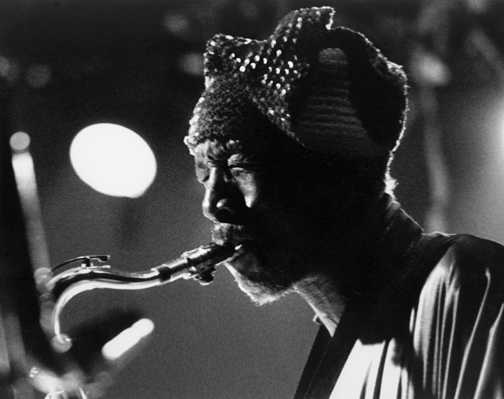
Top - Marshall Allen; bottom, John Gilmore
Toward the end of his life, Ra had taken to calling it "world music" which seems quite appropriate considering, at the time this article was written (early 1990’s), the Arkestra had just returned from a month-long tour of cities in Switzerland, Austria, Germany and the Netherlands. The following month they were to embark upon a concert tour of Madrid, Istanbul and were slated to perform in Moscow at a symposium honoring Soviet cosmonauts.
"You'll never have world peace until you have world music," Ra once intoned during an early-1990's lecture at Boston's Northeastern University. "World music is the one thing that can make this planet harmonize."
MUSIC HAS WINGS
Indeed. It was conjecture along these lines in conjunction with his unique musical approach that helped evoked some skepticism of Ra and his music for many years. Early on, the group was dismissed as charlatans -- mere starry-eyed followers of a cult of personality no doubt due, in large part, to the ancient Egyptian culture and space-age science-fiction that comprised the Arkestra's musical underpinnings. In some circles, that criticism persisted throughout his career and beyond. For his part, however, Ra seemed to focus scant attention on such criticism, deciding instead to concentrate strictly on expanding the boundaries of his music.
"Music has wings," Ra once stated. "It moves upon the wings of intuition and thought. Like the wind. It goes everywhere; it blows everywhere."
The same could be said for a Sun Ra performance. To attend one is to bear witness to nothing less than an extraordinary often-participatory spectacle. Indeed, with the chanting that is a part of many Ra compositions, flashing lights, brightly costumed musicians (who make frequent excursions into audiences) and a powerfully surreal set, his performances can seem more like interstellar vaudeville than a musical event.
Ra, however, has always maintained that a method lies within what might seem musical madness. He believed that notes should not be "played" so much as "individualized," an approach that resulted in Ra's signature musical characteristic: his uncanny manipulation of sound within an orchestral context.
The seed of that approach was implanted early. Born in 1914 in Birmingham, Alabama, Ra led bands in both high school and at Alabama A&M, which provided him a scholarship. After leaving college, he moved to Chicago where he wound up working with the great jazz pianist, band leader and arranger Fletcher Henderson, who, along with Duke Ellington, were considered Ra's strongest musical influences. He also played with Gene Wright's "Dukes of Swing," Stuff Smith, and legendary tenor saxophonist Coleman Hawkins.
In 1955, he began recording with the 15- to 20-member Arkestra, and eventually recorded well over 100 albums, many on his own "El Saturn" label. That the Arkestra, which essentially began as a "hard-bop" ensemble that evolved into a "free" orchestra, has lasted up to and beyond Ra's passing, is in itself a significant accomplishment considering the financial hardships even many mainstream jazz bands faced during the 1950s.
Nevertheless, its core members: lanky tenor saxophonist John Gilmore; the physically and vocally mesmeric Tyson, who also played violin; baritone saxophonist Pat Patrick (father of Massachusetts Governor Deval Patrick) and fiery alto saxophonist Marshall Allen, were Sun Ra disciples in the strictest sense, having played virtually their entire careers with Ra. Other long-time members include: bassist Ronnie Boykins; trombonist Julian Priester; bass clarinetist Elo Omo; and Michael Ray on trumpet.
Over the years, there have been any number of avant-garde jazz musicians who have sought to join them as Sun Ra disciples. Yet many of these free improvisationalists have learned, for reasons some might consider surprising, that they were unable to cut it.
With the Arkestra, it ain't just about stretchin' out. It's gotta swing.
"Stay where you are if you are one of the freedom boys," Ra advised many years ago. "Because I am dealing with discipline."
A similar warning could be gleaned from a poem written by Ra entitled: You Must Choose which includes the following passage:
A widening of concepts is necessary
Another look at the future is required
And you must choose
There is no other way
Indeed. Rest in Peace, Sun Ra.
LINKS:
See/hear Sun Ra: http://www.youtube.com/watch?v=x2e_p69_de8
Sun Ra record reviews: http://www.warr.org/sunra.html


